The Gift I Never Could Have Earned
As I shared in yesterday’s lesson, I was having lunch with my colleague, Judith Bauer, when our conversation took an unexpected spiritual turn.
Up until then, I had been pouring out my heart.
Looking back, I realize I didn’t understand either God’s holiness or His mercy. I believed God owed me a different life because I thought I was basically a good person. I had no idea that if God gave me what I truly deserved, it wouldn’t be a healthier child or an easier life—it would be eternal judgment.
That lunch conversation exposed just how much I still had to learn about who God really is.
I was bellyaching about how unfair life seemed.
I didn’t think I deserved to have a child with a disability. After all, I had prayed for that baby every single day of my pregnancy. Yet there were people who never prayed once for their babies, and they gave birth to healthy children.
Over the years, I have met many people who have experienced heartbreaking tragedies and simply could not understand why God would allow them.
There is one thought from Dr. James Dobson’s book When God Doesn’t Make Sense that has stayed with me ever since I read it. He said, in essence, that when God doesn’t make sense, it isn’t God who doesn’t make sense—it is our understanding of Him that is skewed.
Boy, was he right.
That perfectly described where I was. The problem wasn’t God’s character. The problem was that I didn’t yet understand His holiness, His justice, or His mercy. I was evaluating God through the lens of my circumstances instead of allowing Scripture to reveal who He truly is.
We ask, “Why did she get lung cancer and not the two-pack-a-day smoker down the street?”
Why was a husband killed in an airplane or automobile accident while his wife was pregnant with their fourth child?
Why, out of all the men and women serving our country, was their loved one the one who never came home?
In their grief, many become angry with God. They look around and see people who have no interest in following Him, yet their lives seem untouched by tragedy. Eventually, the question rises from the depths of their heart:
“This isn’t fair. Why me?”
Deep down, I was asking the very same question so many of us ask:
“Why do bad things happen to good people?”
Judith listened patiently.
Then she looked at me and said something that stopped me in my tracks.
“Cindy, if you got what you deserved, you’d go to hell.”
“What in the world are you talking about?” I asked, my voice revealing the shock and agitation I felt.
How could she possibly say something like that?
I’d gone to church my entire life, taught Sunday school and read my Bible.
Surely she wasn’t talking about me.
I honestly believed I was a good person.
I think most people feel the same way.
We don’t rob banks.
We try to help people.
We pray.
Somewhere along the way, we quietly begin adding all those things together and come to one conclusion:
“I’m basically a good person.”
But then God asks a question that changes everything.
Compared to whom?
For years, I compared myself to other people.
I could always find someone whose sins seemed more obvious than mine.
But one day I realized something that completely changed my perspective.
God never compares me to other sinners.
He compares me to His perfect holiness.
Suddenly…
My scorecard fell apart.
The Bible says,
“For all have sinned and fall short of the glory of God.” (Romans 3:23)
Notice what it doesn’t say.
It doesn’t say most people have sinned.
It says all.
That includes me.
And that includes you.
As I honestly examined my heart, I began to see sins I had overlooked for years.
My pride, unforgiving spirit and gossip.
Outwardly, I looked like a faithful Christian.
Inwardly, I was discovering how desperately I needed God’s mercy.
Then another verse arrested my attention:
“But we are all like an unclean thing, and all our righteousnesses are like filthy rags…” (Isaiah 64:6)
Isaiah doesn’t say our worst deeds are like filthy rags.
He says our righteousnesses—our very best efforts—can never make us acceptable before a perfectly holy God.
That truth humbled me.
Everything inside me wanted to believe my goodness counted for something.
At that point, the Bible became a magnet. I couldn’t get enough of God’s Word. It was as though scales were falling from my eyes. I had been reading the Bible for years, but now I was beginning to see its truth in a way I never had before.
God was showing me that no amount of goodness could ever make me righteous before a holy God.
As those truths began to sink in, I was horrified.
For the first time, I saw myself the way God did.
I wasn’t just someone who had made a few mistakes.
I was a sinner.
And sin has to be paid for.
There was only one way that payment could ever be made.
Jesus said,
“I am the way, the truth, and the life. No one comes to the Father except through Me.” (John 14:6)
There are not many paths to God.
There is one.
That way is through the shed blood of Jesus Christ.
Every person has a choice. We can either accept God’s free gift of salvation through Jesus or reject it. Those who reject Jesus are choosing to remain separated from God. The Bible teaches that hell is the place of that eternal separation—a place where those who reject God’s provision for their sin receive the just punishment their sins deserve.
God doesn’t want anyone to perish (2 Peter 3:9). That’s why He sent His Son. But because God gives us the freedom to choose, He also allows us to live with the consequences of that choice. Rejecting Jesus means rejecting the only way to be forgiven and spend eternity with God.
But God, in His incredible mercy, made a way.
Jesus Christ, the sinless Son of God, shed His blood on the cross, died as our substitute, and took upon Himself the punishment we deserved.
Anyone who places their faith and trust in Him alone is completely forgiven because Jesus paid the debt in full.
I read those verses before, but this time they truly sank in.
I finally understood.
I realized I didn’t need God to give me what I thought I deserved.
I needed Him to save me from what I actually deserved.
That realization changed my life—radically.
It changed the way I saw myself.
It changed the way I saw God.
And from that day forward, I have been filled with a gratitude that has never left me.
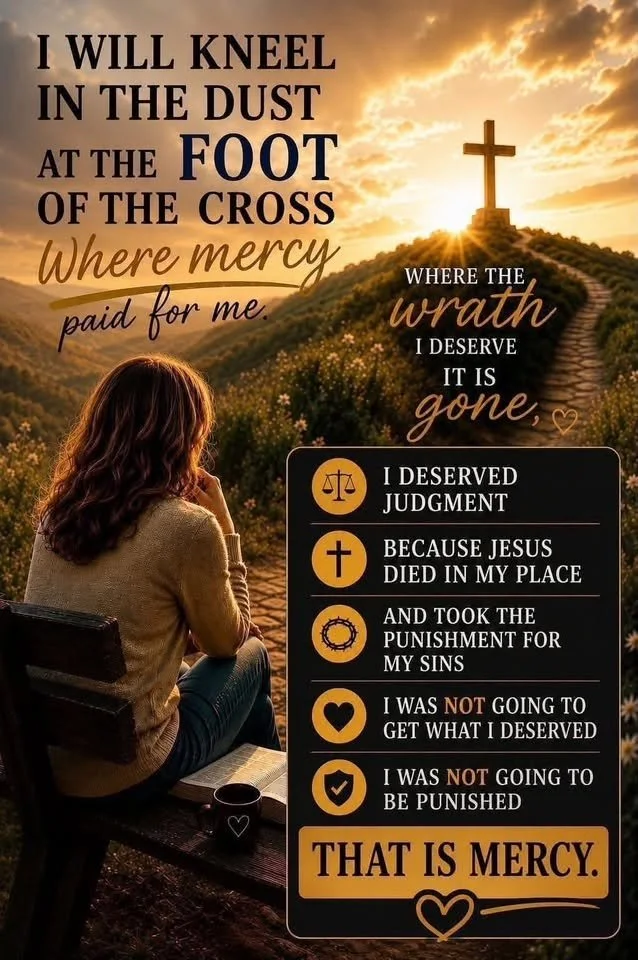
Tomorrow we’ll stand at the foot of the cross and discover how God’s mercy and God’s justice met in one place—where Jesus willingly took the punishment I deserved so I could receive the mercy I never could have earned.
⸻
Share Your Thread
Judith didn’t change my life that day.
God did.
But God used Judith’s words to challenge everything I thought I knew. They sent me searching the Scriptures because I wanted to know God as He truly is—not as I imagined Him to be or even as others had described Him.
As I opened His Word, I discovered that the answers had been there all along. For thousands of years, God has faithfully preserved His truth, and through those ancient words He changed my heart, renewed my mind, and revealed His character in ways I had never understood before.
That’s why I write these devotionals.
Not because I have all the answers.
Not because I want anyone to follow me.
My prayer is simply this: that God would use His Word to awaken in you the same hunger He awakened in me—a desire to know Jesus Christ more deeply, love Him more fully, and follow Him more faithfully.
If this study is helping you see Jesus more clearly, would you consider sharing it with someone who might want to join us? I’d also love to hear what God has been teaching you along the way.
May He receive all the glory, all the honor, and all the praise.