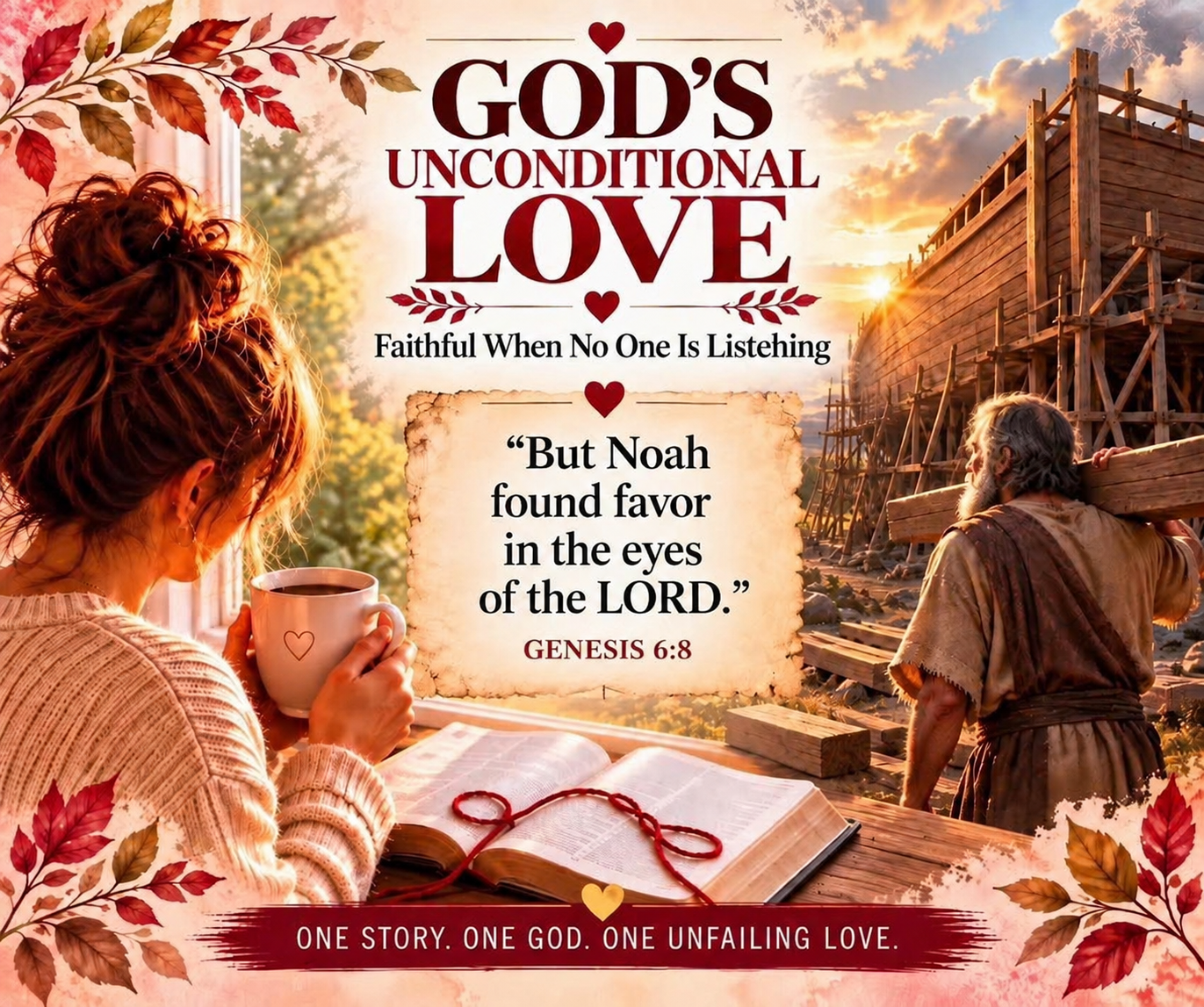
FAITHFUL WHEN NO ONE IS LISTENING
One Story. One God. One Unfailing Love.
PROPHECY IS NOT GIVEN TO SCARE US. IT’S GIVEN TO PREPARE US.
I’ve taught prophecy many times, but as I thought about Noah, I realized something I had never really considered before: Noah was a prophet.
God gave him information about the future that he could know no other way. Noah didn’t have a Bible to read. He didn’t have the writings of earlier prophets. He didn’t have a book explaining what was about to happen.
God spoke to Noah. (Genesis 6:13–21)
And what God told him must have sounded unbelievable.
A flood was coming.
But before we rush to the ark, we need to understand why the flood was coming.
The world of Noah’s day had become almost unrecognizable. Genesis says, “the earth was filled with violence.” (Genesis 6:11) God saw that the wickedness of humanity had become great and that every inclination of the human heart was continually evil. (Genesis 6:5) The earth itself had become corrupt in God’s sight. (Genesis 6:12)
This wasn’t simply a world where people occasionally made bad choices.
Evil had become pervasive.
Violence was everywhere. Moral boundaries had collapsed. And God saw it all.
His heart was deeply grieved. (Genesis 6:5–6)
So when God told Noah that judgment was coming, it wasn’t an arbitrary decision. The world had become so corrupt that God was going to judge the evil that had consumed it. (Genesis 6:11–13)
And this is where God’s unconditional love shines through—He warned them first.
God could have brought the flood without explanation. Instead, He spoke to Noah, and Noah became the messenger.
Hebrews tells us that Noah was “warned by God concerning events as yet unseen.” By faith, he built the ark. (Hebrews 11:7)
Think about what that means.
Noah was telling people about something that had never happened before and that they had no way of knowing was coming.
He had only one thing:
God had spoken.
And Noah preached.
Peter calls him “a preacher of righteousness.” (2 Peter 2:5)
Can you imagine what it must have been like? There is Noah, building an enormous ark on dry land while the world continues living around him. People are working, eating, drinking, making plans, getting married, raising families. Life appears to be going on exactly as it always has.
And Noah keeps warning them.
“Judgment is coming.”
“God has told me a flood is coming.”
“Get ready.”
And they didn’t listen.
But Noah kept building.
He couldn’t make them listen. He couldn’t make them believe. He couldn’t make them repent.
He could only be faithful to the message God had given him.
And Jesus later pointed directly back to those days.
In Matthew 24:37 Jesus said, “For as were the days of Noah, so will be the coming of the Son of Man.”
Jesus explained that before the flood, people were eating and drinking, marrying and making plans right up until the day Noah entered the ark. They were living ordinary lives, completely unprepared for the judgment that was coming. (Matthew 24:38–39)
Notice what Jesus was saying.
The world was filled with corruption and violence, yet people had become so accustomed to their way of life that Noah’s warning didn’t interrupt their plans.
And isn’t that what makes prophecy so important?
God tells us what is coming because He doesn’t want us to be caught unaware.
He warned Noah’s generation because He loved them.
And He warns us because He loves us.
That’s why prophecy isn’t given to scare us.
It’s given to prepare us.
Noah knew something they didn’t know.
God had told him.
And that is our confidence too.
We don’t know the future because we’re smarter than anyone else.
We know what God has revealed because God has spoken.
Then came the day when the ark was finished.
The animals entered. (Genesis 7:8–9)
Noah and his family went inside. (Genesis 7:13)
Then Genesis gives us one of the most sobering sentences in the entire story:
“Then the LORD shut him in.” (Genesis 7:16)
The door closed.
And then…the rain began.
The flood came exactly as God had said it would. (Genesis 7:17–24)
Suddenly, the man they had laughed at was standing inside the very ark they had refused to enter.
Noah hadn’t been trying to win an argument. He hadn’t been trying to prove that he was right.
He was trying to warn people about what God had told him was coming.
And that is what sharing Bible prophecy is about.
We are simply telling people, “God has told us. Be ready.”
Noah couldn’t make the people respond.
Neither can we.
But Noah was faithful.
God wasn’t asking Noah to control the response. He was asking him to trust Him and faithfully deliver the warning.
The same is true for us.
Prophecy doesn’t need to make us afraid of the future. It should make us ready for it. It should turn our eyes toward Jesus. It should make us take God’s Word seriously.
And it should remind us that when God tells us something is coming, He knows what we cannot see.
The same God who knew the flood was coming knows exactly where our story is going.
God has spoken through the Scriptures.
The greatest evidence of His love isn’t that He tells us everything will be easy.
It’s that He loves us enough to tell us the truth.
His warnings are not the opposite of His love.
They are evidence of it.
A WORSHIP MOMENT
As I thought about Noah trusting God when he couldn’t see what was coming, one song came to mind: “Trust in God” by Elevation Worship.
Listen to it today and let its message remind you that our confidence isn’t in what we can see. It is in the God who knows the beginning, the middle, and the end.
Noah trusted God before the rain came.
And we can trust Him before we see what comes next.
One Story. One God. One Unfailing Love.
TOMORROW
The waters have finally receded. Noah opens the door and steps onto dry ground.
But God isn’t finished.
He is about to make a promise that will stretch across generations—and place a sign in the sky that will remind the world:
God keeps His promises.