The Innocent Died for the Guilty
Have you ever pretended you understood something you really didn’t?
Be honest.
Have you ever sat in a Sunday school class, Bible study, or church service while someone used a big theological word and everyone around you nodded knowingly…
…while you were secretly thinking,
“What in the world does that mean?”
You glance around the room.
Nobody looks confused.
Nobody raises a hand.
So you do what most of us do.
You pretend you understand and hope no one asks you to explain it.
That was me.
I was sitting around a table with five other people studying Genesis 3 when our Bible study leader, Judith Bauer, made a statement that stopped me in my tracks.
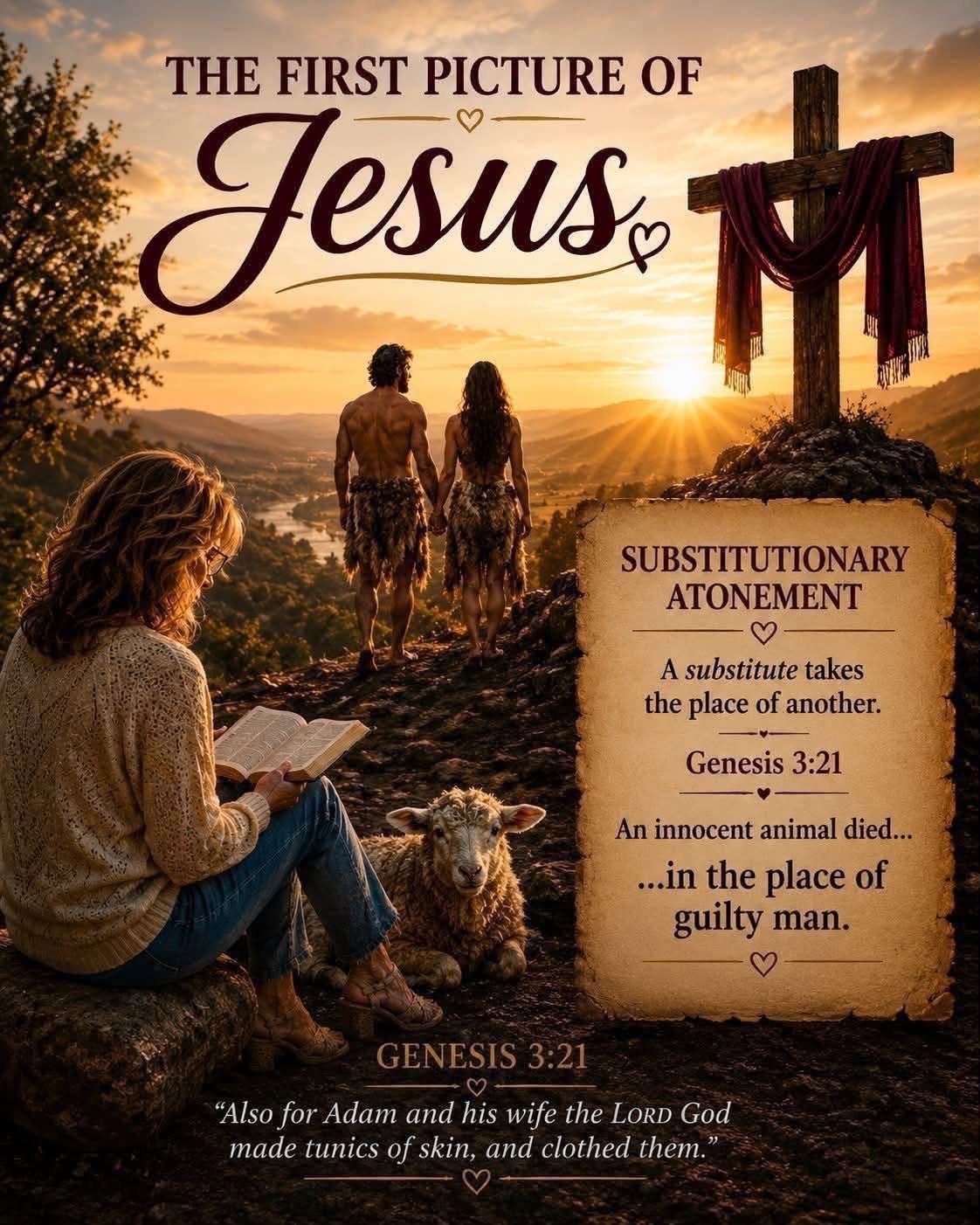
“Genesis 3:21 is the first picture of substitutionary atonement in the Bible.”
I blinked.
Substitutionary…what?
I looked around the table.
Nobody else seemed puzzled.
Everyone simply kept reading as if she had said, “Let’s read the next verse.”
Meanwhile…
I was completely lost.
Finally, I did something I almost never did.
I raised my hand.
“I have no idea what you’re talking about,” I admitted.
“What is substitutionary atonement?”
Looking back, I’m so thankful I asked.
Bible study should be a safe place—a place where people feel free to ask questions, admit they don’t understand, and grow together without fear of embarrassment or judgment.
So…
What does the Bible teach?
One of the clearest explanations is found in 1 Peter 3:18:
“For Christ also suffered once for sins, the righteous for the unrighteous, that he might bring us to God.” (ESV)
Substitutionary atonement isn’t a doctrine theologians invented centuries later. It’s simply a concise way of describing what the Bible has taught all along.
Jesus suffered for our sins.
The Righteous One died for the unrighteous.
He took our place so we could be brought back into a right relationship with God.
That’s substitutionary atonement.
It may sound like a complicated theological phrase, but the truth is wonderfully simple.
As a teacher, I understood substitutes. Whenever I was sick, someone else stepped into my classroom and took my place for the day.
Jesus became our Substitute in a far greater way.
I deserved the punishment for my sin.
You deserved the punishment for your sin.
But Jesus willingly stepped into our place.
Simply stated…
The innocent died for the guilty.
Imagine standing before a judge, guilty and unable to pay your debt. Justice demands a sentence. Then an innocent man steps forward and says,
“I’ll take her place.”
He receives your punishment so you can walk away free.
That’s what Jesus did for us.
God didn’t ignore our sin or pretend it didn’t matter. He placed the punishment we deserved on His own Son. Jesus paid our debt in full so everyone who trusts in Him can be completely forgiven.
Then we went back to Genesis.
Genesis 3:21 says,
“And the LORD God made for Adam and for his wife garments of skins and clothed them.”
At first glance, it seems like an ordinary verse.
But it isn’t.
Adam and Eve had sinned. They tried to cover their shame with fig leaves, but human effort could never cover sin.
So God stepped in.
To make garments of skin, an innocent animal had to die.
For the very first time in Scripture, God painted a picture that pointed ahead to Jesus.
The animal in Eden did not remove Adam and Eve’s sin.
It pointed forward to the One who would.
Thousands of years later, Jesus—the spotless Lamb of God—came to do what no animal sacrifice could ever accomplish.
He bore our sin once for all.
Suddenly Genesis 3 wasn’t just the story of humanity’s fall.
It became the first whisper of redemption.
The first glimpse of the cross.
The first brushstroke in God’s masterpiece of salvation.
That was my “aha!” moment.
The animal in Eden was only a shadow.
Jesus is the reality.
The innocent died for the guilty.
That truth changed the way I read my Bible.
I began looking for Jesus—not just in the Gospels, but throughout the entire Bible.
And once you begin seeing Him in Genesis…
you start seeing Him everywhere.
Because the Bible isn’t a collection of disconnected stories.
It is one beautiful story.
One Author.
One plan.
One Redeemer.
From Genesis to Revelation, God has been pointing us to one Person:
Jesus Christ.
Of course, I couldn’t keep that discovery to myself.
Years later, when I taught Genesis to my senior adult Bible class—including my ninety-six-year-old friend, Sara—I couldn’t wait to show them what Judith had shown me years earlier.
Watching their eyes light up reminded me that discipleship is simply passing on what God has faithfully taught us.
Perhaps God is teaching you something today that isn’t just for you.
Someday He may place someone in your life who needs the very truth He’s teaching you right now.
So never be afraid to ask an honest question.
One honest question changed the way I read my Bible.
And ever since that day…
I’ve never stopped finding Jesus.
Before you go, let me encourage you with one more thought.
If today’s devotional helped you understand God’s Word a little better, why not invite a friend to join you? Share today’s lesson, then talk about it together. Ask, “What stood out to you?” or “What did God teach you today?”
Some of the sweetest moments of spiritual growth happen in ordinary conversations centered around God’s Word.